Here is how to prepare for the Board Certified Coach exam in three moves. Spend your study hours in proportion to the six domain weights. Learn each domain before you rehearse it under time. Then sit at least one full-length timed practice exam and spend your final days on what it shows you. The plans below fit that approach into two, four or eight weeks.
Every copy includes a $50 coupon for the BCC Exam Prep course and simulator. The Board Certified Coach Exam Study Guide ($49.99) maps each plan below to its sections, and it pays for itself if you continue to the course.
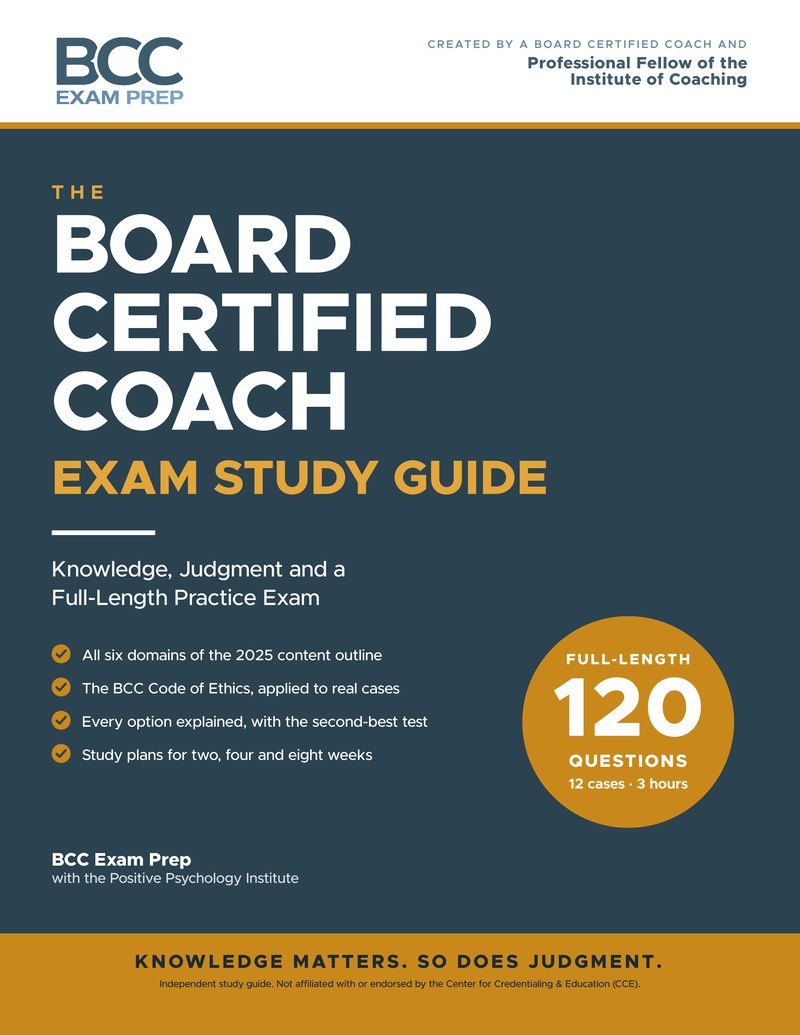
The Board Certified Coach Exam Study Guide
Knowledge, judgment and a full-length, 120-question practice exam with every option explained.
Every copy includes a $50 coupon for the BCC Exam Prep course and simulator.
If your date is close and you want timed practice now, go straight to the BCC Exam Prep course and simulator.
Start with what the exam asks of you
According to CCE’s BCCE Handbook (July 2025), the exam presents 12 case studies. Each is a vignette followed by 10 multiple-choice questions with four options, for 120 items in three hours, or about 15 minutes per case including reading. Of the 120 items, 100 are scored and 20 are unscored pretest items you cannot identify, so prepare as though every item counts.
Two things follow. Knowledge alone is not enough, because the items ask what a competent coach would do in a specific situation. And stamina matters: three hours of careful case reading is a skill you build by rehearsing it. Our overview of what the Board Certified Coach exam measures covers the format in more detail.
Let the domain weights set your study hours
CCE’s 2025 content outline assigns the scored items to six domains. The weights tell you where the points are. The table shows how a 40-hour plan would divide if you followed them exactly.
| Domain | Share of scored items | Hours in a 40-hour plan |
|---|---|---|
| Ethical and Professional Standards | 20% | 8 |
| Agreements and Goal-Setting | 10% | 4 |
| Coach Presence and Applied Skills | 25% | 10 |
| Effective Coach-Client Communication and Rapport | 15% | 6 |
| Facilitating Client Growth and Accountability | 15% | 6 |
| Coaching Business Practices and Professional Development | 15% | 6 |
Then adjust for your own starting point:
- Do not shortchange ethics. It carries 20 percent on its own, and ethical priorities also decide items in the other domains. If you trained under another code, learn where the BCC Code of Ethics differs; start with our guide to the BCC Code of Ethics.
- Give Coach Presence and Applied Skills unhurried time. At 25 percent it is the heaviest domain, and its items ask you to match a method to the client’s state.
- Schedule business practices. It is easy to skim because it feels less like coaching, but it is 15 percent of the scored items.
- Move hours toward your weak areas. Once you have practice results, let them decide where your last week goes.
Reading versus timed practice: why you need both
Reading builds the knowledge the items assume: the BCC Code of Ethics, sound agreements, the major coaching approaches and when each fits, and professional standards. Timed practice builds what reading cannot: recognizing a concept the case never names, choosing between two reasonable answers against the clock, and holding your attention for three hours.
The order matters. Taken before you study, a full-length practice exam mostly measures what you have not yet read; taken after, it shows where your knowledge holds under pressure. A sensible sequence:
- Read a domain, then work its exam-style decisions before checking the answers.
- As you go, add short timed case runs to practice reading vignettes at about 15 minutes per case.
- When the reading is done, sit one full-length exam in a single three-hour block.
- Score it by domain, log every miss by cause, and review the sections your misses point to.
Our Board Certified Coach exam sample questions show what a case-based item looks like and why the second-best answer is the usual trap.
How to prepare for the Board Certified Coach exam in 8, 4 or 2 weeks
Pick the plan that fits your time. Each reads before it practices, includes one full-length timed sitting, and leaves time to review what it shows. Where you can, finish that sitting at least a week before your appointment.
8-week BCC exam study plan for first-time candidates
- Week 1: The exam format and how to read a case; begin ethics. List the standards and models you could not yet explain to a colleague.
- Week 2: Finish ethics; begin agreements and goal-setting. Note where the BCC Code differs from standards you trained under.
- Week 3: Finish agreements; begin Coach Presence and Applied Skills. Rework exam-style cases without looking at the answers.
- Week 4: Coach Presence and Applied Skills, unhurried. It carries a quarter of the scored items.
- Week 5: Communication and rapport. Reread your week 1 list and strike what you now know.
- Week 6: Growth and accountability; begin business practices. Review the BCC Code once more.
- Week 7: Finish business practices. End the week with a full-length practice exam in one three-hour block, then score it.
- Week 8: Review the sections your error log points to. No new material in the last three days.
4-week BCC exam study plan for working coaches with a fixed date
- Week 1: The exam format and ethics. Ethics shapes items in every domain, so give it full attention.
- Week 2: Agreements and goal-setting, then Coach Presence and Applied Skills. Work every exam-style case before reading its answer.
- Week 3: Communication, growth and accountability, and business practices. Do not leave business practices to chance.
- Week 4: A full-length practice exam on the first weekend, then the sections it points to. Keep the last two days light.
2-week BCC exam study plan for retake candidates and experienced coaches
- Days 1 to 2: Check CCE’s current handbook for retest and scheduling rules first. Then the exam format and ethics.
- Days 3 to 5: Coach Presence and Applied Skills, focused on which method fits which client state.
- Days 6 to 8: The remaining domains through their key takeaways and exam-style cases; read the full section wherever a case surprises you.
- Day 9: A full-length practice exam, three hours, scored the same day.
- Days 10 to 13: The sections your error log points to, confident misses first.
- Day 14: Rest. Logistics only.
The study guide prints all three plans with the exact sections to read each week.
When to add timed practice in exam mode
A book can give you one honest full-length rehearsal. If you want more, or want to practice the way the exam feels, add the simulator. Its timed case simulations build from short practice runs to a full-length sitting in exam mode, with feedback held until the section ends, as on the real exam. Its readiness report shows where your results are strongest and weakest, so you know where your remaining hours belong.
The course also includes teaching modules for all six domains, short concept videos, an audio discussion of every module, an explanation for every option, and an extended-time practice path for candidates with CCE-approved accommodations.
Ready for timed, exam-like practice? The BCC Exam Prep course and simulator add timed case simulations in exam mode, a full-length sitting, an explanation for every option and a readiness report. Reading the study guide? Your copy includes $50 off.
Turn every miss into a review list
A practice score tells you how many items you missed; an error log tells you why. For each miss and each lucky guess, note the fact that decided the item and one cause:
- an ethical or safety priority you ranked too low
- an action that drifted outside coaching into therapy, consulting or advice
- a misapplied agreement, sponsor role or confidentiality limit
- a sound method matched to the wrong client state
- the right action at the wrong point in the engagement
- a misread word, a missed fact or an appealing but unsupported option
Mark each miss as sure or unsure. The misses you were sure of matter most, because they reveal a belief the case contradicts. Read the explanation for every option, even on items you answered correctly.
The last week and exam day
Use the last week to consolidate, not to start new material. Reread your error log, revisit the sections it points to, and review the BCC Code of Ethics once more. Keep practice light.
Rehearse a pacing plan: about 15 minutes per case, with checkpoints at roughly 45 minutes after the third case, 90 after the sixth and 135 after the ninth. If one item has taken two minutes, choose the option better supported by facts you can name and move on.
Read CCE’s current BCCE Handbook well before your appointment. It governs eligibility, fees, identification, scheduling, retesting, scoring and the rules of the testing session.
How the study guide and course fit together
Start with the guide; rehearse with the simulator. The Board Certified Coach Exam Study Guide teaches all six domains and includes a full-length practice exam of 12 new cases with every option explained. The course adds repeated timed practice in exam mode and a readiness report. Together they are the most complete BCC preparation we know of.
- If you are curious, try the free sample.
- If you are starting to prepare, the study guide is $49.99 and includes a $50 coupon toward the course.
- If you are ready for timed practice, the course and simulator are $297 (an introductory price through December 31, 2026; $397 from January 1), or $247 with the reader code.
Still weighing your choices? Our comparison of BCC exam prep options sets out what each kind of resource does well.
BCC Exam Prep is independent of the Center for Credentialing & Education (CCE) and is not endorsed by it.
Frequently asked questions
How long should I study for the Board Certified Coach exam?
That depends on where you start. Eight weeks gives a first-time candidate time to read every domain and still review after a full-length practice exam. Working coaches with a fixed date can fit the same work into four weeks. Two weeks suits retake candidates and experienced coaches who mainly need timed rehearsal and targeted review.
Should I take a practice exam before I start studying?
A short timed run early on shows you what case-based items feel like. Save the full-length sitting for after the reading, though. Taken first, it mostly measures what you have not yet studied, and you spend a fresh rehearsal before it can tell you much. Sit it once, under time, at least a week before your appointment.
What score do I need to pass the BCC exam?
CCE sets scoring policy in its current BCCE Handbook, so rely on the handbook rather than on figures you find elsewhere. What you can plan around: 100 of the 120 items are scored, and you cannot tell which 20 are pretest items, so treat every item as scored. A practice score guides your review; it does not predict a pass.
Do I need the course if I have the study guide?
Not necessarily. The guide teaches every domain and gives you one full-length rehearsal with every option explained. The course adds repeated timed simulations in exam mode and a readiness report. If you want that practice, the $50 coupon in every copy brings the course from $297 to $247.
Every copy includes a $50 coupon for the BCC Exam Prep course and simulator.
The Board Certified Coach Exam Study Guide
Knowledge, judgment and a full-length, 120-question practice exam with every option explained.
Every copy includes a $50 coupon for the BCC Exam Prep course and simulator.