The BCC Code of Ethics is the controlling ethics reference on the Board Certified Coach Examination. Published by the Center for Credentialing & Education (CCE) and approved in 2010, it is short, specific and in places different from codes many coaches trained under. Ethical and Professional Standards carry 20 percent of the exam’s scored items, and ethical priorities decide items in the other domains too. Below are the standards that most often decide a question, each with an original example, and the errors candidates trained under other codes tend to make.
Every copy includes a $50 coupon for the BCC Exam Prep course and simulator.
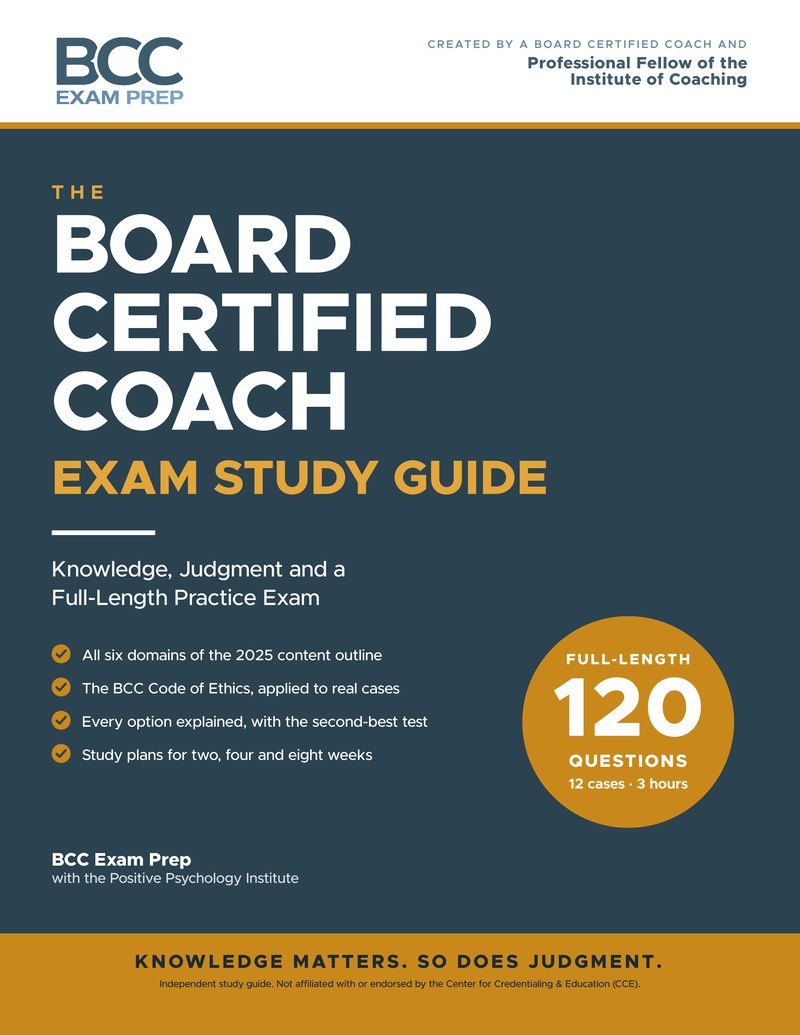
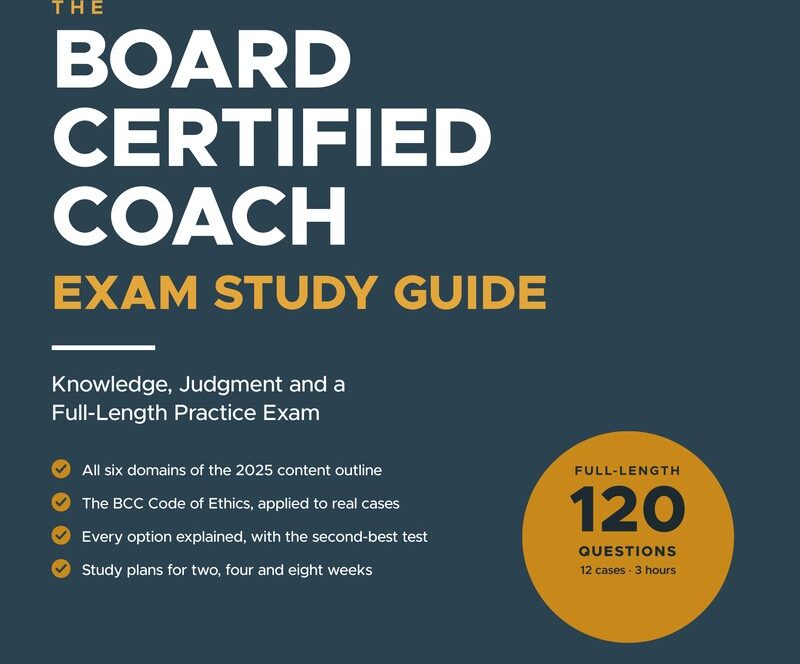
The Board Certified Coach Exam Study Guide
Knowledge, judgment and a full-length, 120-question practice exam with every option explained.
Every copy includes a $50 coupon for the BCC Exam Prep course and simulator.
How the BCC Code of Ethics is organized
Each standard carries a letter and a number. Broadly, the A standards cover legal and conduct matters, the B standards CCE’s policies, the C standards the performance of services and the D standards conflicts of interest. This guide cites them that way, as in “standard C6,” and paraphrases them; read the full Code from CCE for its exact wording. Learn what each standard does not say as well as what it says, because many wrong answers credit the Code with a rule it never makes. A4 (no unlawful discrimination) and A5 (no harassment) need little interpretation.
The BCC Code of Ethics standards that most often decide exam items
Standard C6: a written agreement before coaching begins
C6 calls for a written coaching service agreement before coaching begins, covering the parties’ rights, roles and responsibilities and how private information will be protected. It does not list fees.
Example. Twenty minutes into a free introductory call, a prospect is deep in a decision about relocating, and the coach is asking the questions she would ask in a session. That is coaching, with no agreement in place. The stronger course is to say so, close the call as an introduction and send the agreement before the first session. On the exam, coaching “because the client is ready” is usually right but premature.
Standard C3: confidentiality and its stated limits
C3 asks coaches to protect client information, including electronic files and communications, and to disclose it only when the law requires, the client authorizes or the written agreement permits. Privacy limits are made clear before services begin. A sponsor’s payment is not on the list.
Example. A bank pays for coaching for a branch manager under an agreement that provides only attendance confirmations. An HR partner asks the coach to rate the manager’s “readiness for the next level” from one to five. A rating is an evaluation drawn from sessions, and nothing in C3 permits it, so the coach declines.
Standard A7: danger to self or others
A7 provides that disclosure to government agencies or sponsors may be permitted or required when a client poses a danger to self or others, consistent with the agreement and the law. Danger engages it; distress does not.
Example. An entrepreneur whose funding has collapsed spends a session angry and despairing about two lost years. That is grief and stress; an option invoking disclosure or emergency referral imports a fact the case lacks. Add one detail, a statement that he has been thinking about ending his life, and safety comes first: the coach responds within the session, helps him reach immediate support, and lets the agreement and the law govern any disclosure.
Standards C2 and C7: competence, referral and supervision
C2 asks coaches to practice within their qualifications and know the limits of their competence. C7 calls for referral when the coach cannot appropriately help a client and when a service relationship ends, and for supervision from qualified professionals when necessary.
Example. A client in a career-transition engagement says her teenage son has stopped attending school and asks the coach to help her work out what is wrong with him. Assessing another person, let alone a minor, is outside coaching. The coach acknowledges the worry, suggests suitable professionals, such as the school counselor or the family’s physician, and keeps coaching on her own goals.
Standards C8 and B5: what sponsors must understand
C8 asks coaches to make sure sponsors understand that coaching is not counseling. B5 asks coaches to inform sponsors about the Code.
Example. An HR director asks a coach to “work with” three employees whose managers describe them as struggling with anxiety. The request treats coaching as treatment. In contracting, the coach explains what coaching addresses and what it does not, that clinical concerns are referred, and gives the director the BCC Code.
Standards D1 and D2: disclosing and resolving conflicts
D1 asks coaches to disclose potential or actual conflicts of interest and appearances of impropriety, including to sponsors. D2 asks coaches to avoid conduct that creates conflicts and to take reasonable steps to resolve those that arise.
Example. Midway through an engagement with a hospital system’s finance director, a coach learns that her spouse’s firm is bidding to acquire the system. Even if her judgment is unaffected, an observer could doubt it. Disclosing to client and sponsor at once meets D1 but resolves nothing; under D2 they then decide together whether to continue with safeguards or end with referrals.
Standard D3: multiple relationships
D3 asks coaches to avoid multiple relationships with clients or sponsors. Only when one cannot be avoided does the fallback apply: discuss its potential effects with those involved, take steps to prevent harm and note the discussion in the client record.
Example. Four months into an engagement with an elementary school principal, a boundary change moves the coach’s daughter into the principal’s school. No one chose the overlap. They discuss it, agree that matters involving the child stay out of coaching, and the coach offers referral options in case the principal prefers to end. The discussion goes in the record. A neighbor who asks to be coached is different: that relationship can be declined.
Standards D4 and D5: romance and outside compensation
D4 bars a sexual or romantic relationship with a current client, or with a former client for two years after the relationship ends. D5 bars offering or accepting significant payments, gifts or other compensation outside the written agreement. The Code does not define “significant,” so weigh value, timing and any obligation created.
Example. At the close of an engagement, a client who owns a car dealership offers the coach a new car at cost as thanks. The discount is worth thousands and sits outside the agreement, so the coach declines warmly; a thank-you card would raise no D5 question. If a former client proposes a date twenty months after the final session, D4 decides it just as plainly: the two years have not passed, and mutual consent does not shorten them.
Standards C4 and C5: accurate credentials and explained methods
C4 asks coaches to use credentials, titles and degrees properly and to describe their qualifications and services accurately. C5 asks coaches to tell clients the purpose, application and results of the techniques and assessments they use.
Example. After a two-hour webinar, a coach adds “Certified Emotional Intelligence Practitioner” to her website. A certificate of attendance is not a certification, so under C4 she describes the webinar accurately or removes the line. When she gives a client a strengths inventory, C5 has her explain what it measures, how it will be used and what the results show.
Where candidates trained under other codes go wrong
Many candidates learned another code first. If you trained in an ICF-accredited program, you learned the ICF Code of Ethics, a separate document with its own structure and wording, and licensed professionals bring their own codes. That background helps, but on the BCC exam the BCC Code controls. These errors are common:
- Citing a rule the BCC Code does not contain. The Code has no dedicated standard on marketing, testimonials or fee-splitting; reason from the accuracy duty in C4 and the compensation limit in D5.
- Treating payment or a vague remark as consent. Under C3, a sponsor’s invoice authorizes nothing, and “tell them whatever helps” names nothing specific.
- Bringing clinical habits into coaching. Coaching is not therapy. The BCC answer stays within coaching and refers what lies beyond it (C2, C7).
- Treating emotion as danger. A7 needs facts showing danger to self or others; tears and anger are not those facts.
- Using D3’s fallback as permission. If the coach could decline the second relationship, declining is the answer.
- Stopping at disclosure. Disclosure meets D1 but resolves nothing under D2, and disclosing an outside payment does not bring it inside the agreement (D5).
How to study the BCC Code of Ethics for the exam
Read the full Code once, slowly, and learn the standards above by number. Then work cases, because ethics items arrive as a sponsor’s casual email or a client’s passing remark. Our board certified coach exam sample questions include one built on standard C3, and what the board certified coach exam measures shows how ethics surfaces across all six domains.
The Board Certified Coach Exam Study Guide works through the Code in Part II and ends every section with an exam-style decision and a second-best test. Its author is the developer of the BCC Exam Prep simulation, a Board Certified Coach and Professional Fellow of the Institute of Coaching, who also founded the Positive Psychology Institute. For timed practice, the BCC Exam Prep course and simulator adds case simulations in exam mode, and the free sample lets you try it. Our guide to how to prepare for the board certified coach exam shows how to fit ethics into 2, 4 and 8 week plans.
Ready for timed, exam-like practice? The BCC Exam Prep course and simulator add timed case simulations in exam mode, a full-length sitting, an explanation for every option and a readiness report. Reading the study guide? Your copy includes $50 off.
BCC Exam Prep is independent of the Center for Credentialing & Education (CCE) and is not endorsed by it.
Frequently asked questions
Does the BCC Code of Ethics require fees in the coaching agreement?
Not by name. Standard C6 calls for a written agreement before coaching begins, covering the parties’ rights, roles and responsibilities and how private information will be protected. It does not list fees. A sound agreement includes fees, payment and cancellation terms anyway, but an exam option that rests on C6 requiring a fee schedule rests on a misreading.
How long does the BCC Code require coaches to keep records?
Five years. Standard A6 asks coaches to keep records for five years and then dispose of them in a way that protects client privacy, such as shredding paper files and securely deleting electronic ones. Applicable law where you practice may add requirements of its own, so check it as well, and consult an attorney if you are unsure.
Is the BCC Code of Ethics the same as the ICF Code of Ethics?
No. They are separate documents from separate organizations, with different structure and wording. Coaches who trained in ICF-accredited programs often know the ICF Code well, and that is useful background, but the Board Certified Coach exam applies the BCC Code. When the two seem to differ, or one speaks where the other is silent, answer from the BCC Code.
Start with the guide; rehearse with the simulator. Every copy of the study guide includes a $50 coupon for the BCC Exam Prep course and simulator.
The Board Certified Coach Exam Study Guide
Knowledge, judgment and a full-length, 120-question practice exam with every option explained.
Every copy includes a $50 coupon for the BCC Exam Prep course and simulator.