The Board Certified Coach (BCC) is a single credential issued by the Center for Credentialing & Education (CCE), while the International Coaching Federation (ICF) issues three tiered credentials: Associate Certified Coach (ACC), Professional Certified Coach (PCC) and Master Certified Coach (MCC). The BCC requires a bachelor’s degree, 30 to 120 hours of coach-specific training depending on your background, 30 hours of coaching experience and a case-study exam, while ICF lists no degree requirement but asks for more paid coaching hours, mentor coaching and a recorded performance evaluation. You can hold both, and a current ICF credential cuts the BCC training requirement from 120 to 60 hours for applicants who do not qualify for a shorter pathway.
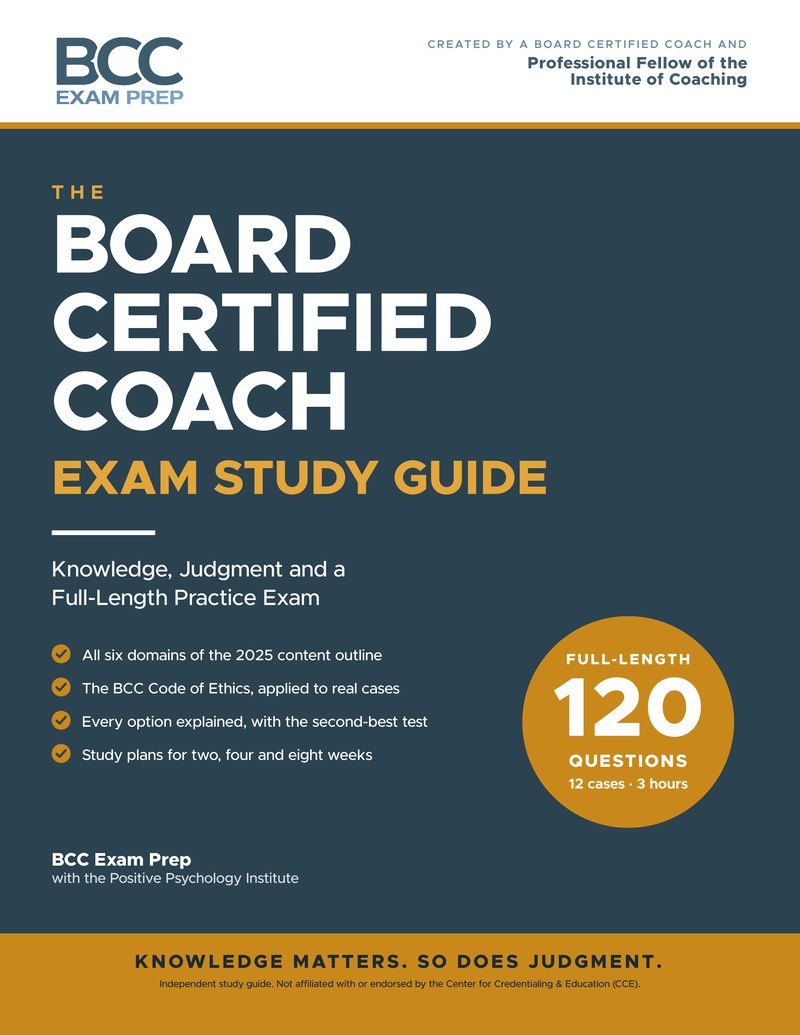
The Board Certified Coach Exam Study Guide
Knowledge, judgment and a full-length, 120-question practice exam with every option explained.
Every copy includes a $50 coupon for the BCC Exam Prep course and simulator.
Who issues the BCC and the ICF credentials
The BCC is issued by CCE, a nonprofit founded in 1995 as an affiliate of the National Board for Certified Counselors (NBCC), according to CCE’s BCC overview page. The ACC, PCC and MCC are issued by ICF, an international coaching organization that also accredits coach training programs.
The two systems are separate: earning one does not award the other. Figures below come from CCE’s BCC Credential Eligibility Policy (last updated July 3, 2025), CCE’s BCCE Handbook (updated July 1, 2025) and ICF’s credential, exam and renewal pages, checked in October 2026.
Eligibility: degree, training, experience and endorsements
BCC eligibility
Every BCC applicant needs a bachelor’s or graduate degree in any field, according to CCE’s BCC Credential Eligibility Policy. The required amount of CCE-approved coach training depends on your background:
- 30 clock hours: a master’s degree in business administration, social sciences or behavioral health, plus an active state license or national certification.
- 60 clock hours: the same master’s degree without a license or certification.
- 60 clock hours: a current ICF ACC credential or higher, plus a bachelor’s degree in any field.
- 120 clock hours: all other applicants.
CCE also requires at least 30 hours of post-degree coaching experience, verified by a coach, colleague or supervisor, and one positive professional endorsement from someone who is not a relative. CCE’s policy does not require mentor coaching or a recorded session review.
ICF eligibility
ICF’s credential paths page lists no degree requirement. Each level instead raises the training and paid experience required:
- ACC: 60 or more hours of coach-specific education and 100 or more coaching hours (75 paid) with at least 8 clients, including 25 hours within the 18 months before you apply.
- PCC: 125 or more hours of education and 500 or more coaching hours (450 paid) with at least 25 clients, including 50 hours within 18 months.
- MCC: 200 or more hours of education, a current or previous PCC, and 2,500 or more coaching hours (2,250 paid) with at least 35 clients.
ICF Portfolio applicants complete 10 hours of mentor coaching over at least three months and submit recorded sessions with transcripts (one for the ACC, two for the PCC and MCC). ACC and PCC applicants from ICF Level 1 or Level 2 programs complete both inside their program. ICF lists no endorsement requirement.
BCC vs ICF at a glance
| Factor | BCC (CCE) | ICF ACC, PCC and MCC |
|---|---|---|
| Levels | One credential, with optional specialty designations | Three tiers: ACC, PCC, MCC |
| Degree | Bachelor’s or higher, any field | None listed |
| Coach-specific training | 30, 60 or 120 clock hours of CCE-approved training, by background | ACC 60+, PCC 125+, MCC 200+ hours |
| Coaching experience | 30 post-degree hours | ACC 100+ (75 paid); PCC 500+ (450 paid); MCC 2,500+ (2,250 paid) |
| Mentor coaching | Not required | 10 hours on Portfolio paths, or built into Level programs |
| Recorded performance evaluation | Not required | Required (completed inside Level 1 and 2 programs for ACC and PCC) |
| Endorsement | One professional endorsement | Not listed |
| Exam | BCCE: 12 case studies, 120 items (100 scored), 3 hours | ACC Exam: 60 items, 90 minutes. PCC and MCC: 78 items, 180 minutes |
| Application fee | $279, or $229 for NCCs (includes the exam) | ACC $175 to $625; PCC $375 to $900; MCC $675 to $825 |
| Renewal | Every 5 years: 70 CE clock hours (4 in ethics), plus $40 a year | Every 3 years: 40 CCE credits (3 in ethics), $175 or $275 |
| Ethics code | BCC Code of Ethics | ICF Code of Ethics (2025) |
The exams: BCCE vs the ICF exams
The Board Certified Coach Examination (BCCE) has 12 case studies, each a vignette followed by 10 multiple-choice questions, for 120 items (100 scored and 20 unscored) in three hours, according to CCE’s July 2025 BCCE Handbook. You can test at a Pearson VUE center or online through OnVUE. Our guide to what the Board Certified Coach exam measures covers its six content domains.
ICF uses two exams. The ACC Exam has 60 multiple-choice knowledge questions in 90 minutes, according to ICF’s ACC Exam page. The ICF Credentialing Exam for PCC and MCC candidates has 78 situational judgment items, each asking for the best and worst of four actions, in 180 minutes, according to ICF’s Credentialing Exam page. Both are scored from 200 to 600 with 460 needed to pass, delivered by Pearson VUE in person or online, and offered in 16 languages.
The PCC and MCC exam is changing. ICF’s candidate guide, published July 27, 2026, says an updated exam with 80 items (44 situational judgment and 36 knowledge-based) and a 150-minute limit begins November 10, 2026, and that March 31, 2027 is the last day to take the current version.
Cost comparison
The BCC application and exam fee is $279, or $229 for National Certified Counselors, according to CCE’s BCC Costs page. CCE’s BCCE Handbook lists a $100 fee for each exam reregistration, and BCCs pay a $40 annual maintenance fee.
ICF application fees run $175 to $625 for the ACC, $375 to $900 for the PCC and $675 to $825 for the MCC, depending on path and ICF membership, according to ICF’s credential paths page. The lowest ACC fee, $175 for members ($325 for nonmembers), applies to Level 1 and Level 2 program graduates. Neither organization’s fees include coach training tuition, which you pay to your training provider.
Renewal and continuing education
BCCs recertify every five years, completing 70 clock hours of continuing education per cycle, including at least 4 in coaching ethics and 10 in each optional specialty designation held, according to CCE’s BCC continuing education page. BCCs also pay the $40 maintenance fee each year.
ICF credentials renew every three years. ICF’s renewal page requires 40 Continuing Coach Education credits per cycle, at least 24 of them in Core Competencies (including 3 in Coaching Ethics). ACC holders must include 10 hours of mentor coaching. Renewal costs $175 for ICF members and $275 for nonmembers. ICF’s “CCE” credits are unrelated to the Center for Credentialing & Education.
Which code of ethics applies
BCC holders and applicants are bound by the BCC Code of Ethics, which CCE says applies regardless of a coach’s other affiliations or credentials. ICF members and credential holders pledge to uphold the ICF Code of Ethics, whose current version took effect April 1, 2025; ICF says its exams still use the 2020 Code. A coach who holds both credentials answers to both codes. For how ethics appears on the BCC exam, see our BCC Code of Ethics exam guide.
How an ICF credential shortens the BCC path
A current ICF ACC, PCC or MCC plus a bachelor’s degree in any field lowers the BCC training requirement to 60 clock hours of CCE-approved coach training, compared with 120 hours for applicants in CCE’s general pathway, according to CCE’s eligibility policy. Check CCE’s approved training list before assuming your ICF program hours count.
The rest of the BCC process still applies: 30 hours of post-degree coaching experience, one professional endorsement and a passing BCCE score. Many ICF holders already meet the experience requirement, provided their coaching hours came after their degree. Our step-by-step guide on how to become a Board Certified Coach covers the full sequence.
Which credential suits you
The BCC is often a good fit if you:
- hold a qualifying master’s degree, especially with a license or national certification, which shortens training to 30 or 60 hours;
- are earlier in practice, since 30 post-degree coaching hours is a lower bar than the ACC’s 100;
- prefer an exam-based assessment without mentor coaching or a recorded session review.
An ICF credential is often a good fit if you:
- do not hold a bachelor’s degree, since ICF lists no degree requirement;
- want a tiered path that recognizes growth from ACC to PCC to MCC;
- want mentor coaching and feedback on recorded sessions built into the process;
- want to test in a language other than English (ICF offers 16 languages, while CCE’s FAQ says the BCCE is offered only in English).
The choice is not either/or, since you can hold both.
Preparing for the BCC exam
If you choose the BCC, start with the free BCC Exam Prep sample to try the case-study format. For a full rehearsal, The Board Certified Coach Exam Study Guide includes a full-length, 120-question practice exam with every option explained, plus a $50 course coupon inside.
When you are ready for timed practice with case-study vignettes, the full course is the next step.
Ready for timed, exam-like practice? The BCC Exam Prep course and simulator add timed case simulations in exam mode, a full-length sitting, an explanation for every option and a readiness report. Reading the study guide? Your copy includes $50 off.
Frequently asked questions
Is the BCC the same as an ICF credential?
No. The BCC is issued by CCE, and the ACC, PCC and MCC are issued by ICF. Each has its own eligibility rules, exam, fees, renewal cycle and code of ethics, and earning one does not grant the other.
Can I hold both the BCC and an ICF credential?
Yes. According to CCE’s eligibility policy, a current ICF ACC or higher plus a bachelor’s degree reduces the BCC training requirement to 60 clock hours of CCE-approved training. You still need 30 post-degree coaching hours, one professional endorsement and a passing BCCE score.
Which is quicker to earn, the BCC or the ICF ACC?
The BCC requires fewer coaching hours: 30 post-degree hours, compared with at least 100 hours (75 paid) for the ACC. BCC training ranges from 30 to 120 hours depending on your background, while the ACC requires 60 or more.
Do I need a degree for the BCC or an ICF credential?
CCE requires a bachelor’s or graduate degree in any field for the BCC. ICF’s credential paths do not list a degree requirement for the ACC, PCC or MCC.
BCC Exam Prep is independent of the Center for Credentialing & Education (CCE) and is not endorsed by it.
BCC Exam Prep is not affiliated with the International Coaching Federation (ICF).
The Board Certified Coach Exam Study Guide
Knowledge, judgment and a full-length, 120-question practice exam with every option explained.
Every copy includes a $50 coupon for the BCC Exam Prep course and simulator.