The board certified coach exam sample questions below are original and written in the style of the Board Certified Coach Examination (BCCE): one short case, three four-option questions, and the best answer to each with an explanation of every option. Try the questions before reading the answers.
Every copy includes a $50 coupon for the BCC Exam Prep course and simulator.
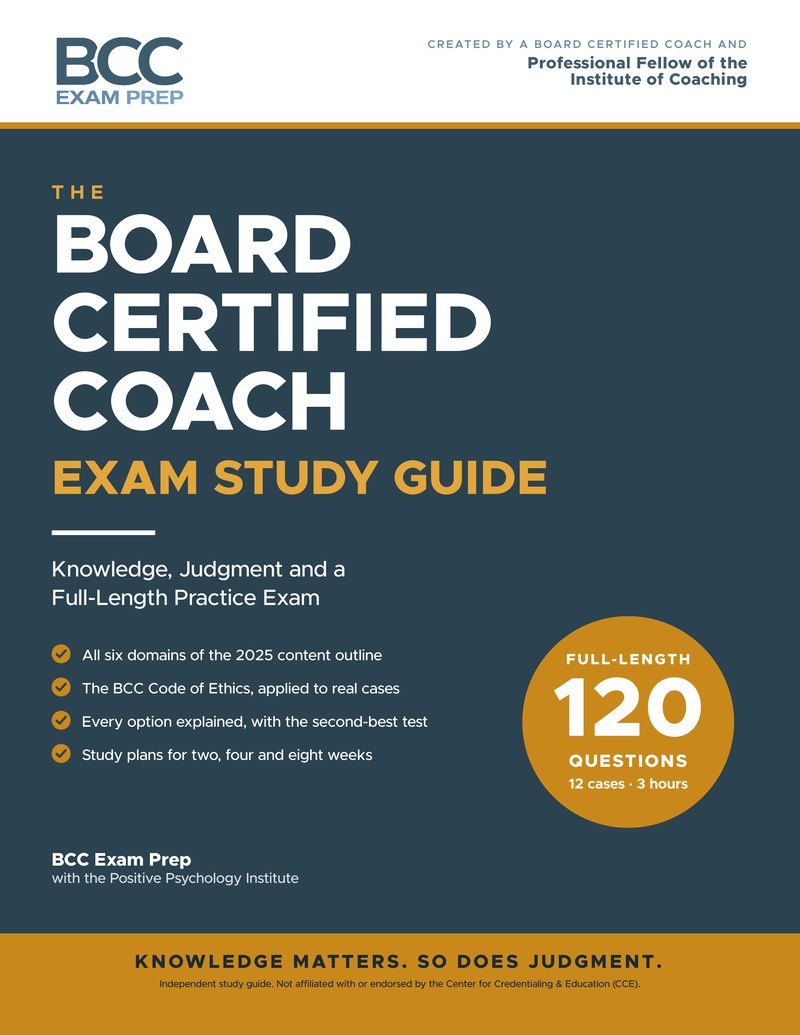
The Board Certified Coach Exam Study Guide
Knowledge, judgment and a full-length, 120-question practice exam with every option explained.
Every copy includes a $50 coupon for the BCC Exam Prep course and simulator.
How case-based questions on the BCC exam work
The BCCE is built from cases. According to CCE’s BCCE Handbook (July 2025), it has 12 case studies, each a vignette followed by 10 multiple-choice questions: 120 items, 100 scored and 20 unscored pretest items, with four options each, in three hours, or about 15 minutes per case.
One vignette supports ten items, and each stem can ask something different of the same facts: what the coach should do first, what to tell a sponsor, where attention belongs. Read the case once for its facts (who the client is, who pays, what was agreed, what has changed, what is missing), then treat each stem as a new instruction. Our overview of what the board certified coach exam measures covers the format and the six domains.
Why the second-best answer is the trap
On a well-written item, the wrong options are rarely absurd. One or two are plainly weak. Another is good coaching in general that is wrong for this case at this moment: it is premature, it skips a step the agreement requires, it makes a decision that belongs to the client, or it depends on a fact the vignette never states. That runner-up is the trap, because a capable coach can defend it.
The study guide teaches a habit for beating it, the second-best test. After choosing an answer, name the runner-up and the one fact that would have made it correct. If that fact is missing from the case, your choice holds. If it is present, you have found your mistake before the exam does. Each explanation below ends with that test.
Sample case: a head brewer at a turning point
Petra Lindqvist has been head brewer at a regional craft brewery for nine years. The brewery’s co-owner, to whom she reports, arranged and pays for six coaching sessions. The written agreement, signed by Petra, the co-owner and the coach, Corwin Ashby, names two goals: preparing Petra to lead the move to a new production facility next spring, and clarifying her long-term career direction. The co-owner receives a note after each session confirming that it took place, and nothing more. The agreement also states that the three of them will review the goals together if circumstances change.
In the third session, Petra says the move has been postponed by a year. A larger brewery has just advertised for a director of brewing operations. “I keep drafting the application and deleting it,” she says. “I love this place. I just can’t tell whether I’m staying because I want to or because it’s easier.”
Two days later the co-owner emails Corwin: “With the move on hold, I’d like the remaining sessions to focus on Petra’s budgeting. Also, between us, is she happy here? I’ve heard she might be looking.”
Three board certified coach exam sample questions
Question 1
When Petra describes drafting and deleting the application, what is Corwin’s best response?
- A. Help Petra set a schedule for finishing the application before the posting closes.
- B. Invite Petra to describe what draws her toward the new role and what keeps her where she is.
- C. Tell Petra that after nine years a new role could renew her energy, and ask what she thinks.
- D. Suggest setting the career question aside until the brewery sets a new date for the move.
Question 2
How should Corwin respond to the co-owner’s question about whether Petra is happy and looking?
- A. Reply that Petra seems settled at the brewery, so there is no cause for concern about her plans.
- B. Reply that the agreement provides only a note confirming each session, so he cannot share content or impressions, and suggest the co-owner ask Petra.
- C. Reply that career direction is one of the goals all three of them signed, and that he can say nothing more than that.
- D. Ask Petra at the next session whether he may tell the co-owner about her interest in the new role, so the sponsor is not surprised.
Question 3
What is the most appropriate way for Corwin to handle the request to refocus the remaining sessions on budgeting?
- A. Agree to the change, since the co-owner pays for the sessions and the facility goal is now on hold for a year.
- B. Raise the request privately with Petra at the next session and let her decide whether budgeting should replace the facility goal.
- C. Reply that the agreement calls for a joint review when circumstances change, and propose that meeting so Petra can weigh the request.
- D. Decline the request, explaining that the goals in a signed agreement stay fixed for the length of the engagement.
Answers and explanations for every option
Question 1: the best answer is B (Coach Presence and Applied Skills)
- A loses on timing. A schedule assumes Petra has decided to apply. She has not.
- B is best. Her words describe ambivalence: real reasons on both sides and no decision. Exploring both sides fits a client still weighing a choice, and career direction is an agreed goal, so the topic belongs here.
- C loses on authority. It ends with a question but opens with the coach’s opinion. The decision is Petra’s, and a coach’s view tips the scale.
- D loses on the agreement. The postponement affects the facility goal, not the career goal she raised.
Second-best test: A is the runner-up. It becomes the best answer if Petra says she has decided to apply and wants help finishing before the deadline.
Question 2: the best answer is B (Ethical and Professional Standards)
- A loses on confidentiality and accuracy. It shares an impression the agreement does not permit, and one that does not match what Petra said.
- B is best. The agreement gives the co-owner one thing: confirmation that each session took place. The BCC Code of Ethics (standard C3) permits disclosure only when the law requires it, the client authorizes it or the written agreement permits it, and none of these applies; “between us” does not create a fourth.
- C loses because context turns a fact into a hint. The co-owner signed the agreement and knows the goals, so restating one looks harmless. As a reply to “is she looking?”, it signals what the sessions have covered.
- D loses on authority. Her authorization would permit disclosure, but nothing calls for seeking it. Asking would serve the sponsor’s curiosity and press Petra to share a decision that is hers, on someone else’s timeline.
Second-best test: C is the runner-up. It becomes the best answer if the co-owner had asked only which goals the remaining sessions would cover, a question the signed agreement already answers.
Question 3: the best answer is C (Agreements and Goal-Setting)
- A loses on goal ownership. A sponsor may propose a goal, but paying does not let the sponsor replace the client’s goals, and the coach cannot accept for Petra.
- B loses on the agreement. Involving Petra is right, but the agreement assigns goal changes to a review by all three signers.
- C is best. The agreement anticipated this moment. Proposing the joint review answers the co-owner, gives Petra a real choice about the request and keeps any revision in writing. What Petra has said in sessions stays private in that meeting unless she chooses to share it.
- D loses on the facts. The agreement does not freeze the goals; it provides a way to revise them.
Second-best test: B is the runner-up. It becomes the best answer if the agreement let Petra and Corwin revise the goals between themselves and simply inform the co-owner.
How to use sample questions in your BCC exam preparation
A single case shows the shape of the exam, not its demands: the real test is twelve cases in a row under time. While you learn, work short sets untimed, read every explanation, including those for questions you got right, and log the fact behind each miss. Once the reading is done, sit a full-length practice exam in one three-hour block. Our guide to how to prepare for the board certified coach exam shows where that sitting belongs in 2, 4 and 8 week plans.
More practice: the study guide and the simulator
The Board Certified Coach Exam Study Guide teaches all six domains, ends every section with an exam-style decision and a second-best test, and includes a full-length practice exam of 12 new cases and 120 questions, sat in three hours, with every option of every question explained. Its cases do not repeat the simulator’s. The author is the developer of the BCC Exam Prep simulation, a Board Certified Coach and Professional Fellow of the Institute of Coaching, who also founded the Positive Psychology Institute.
Print cannot time you or hold back feedback. The BCC Exam Prep course and simulator adds timed case simulations that build from short practice runs to a full-length sitting in exam mode, with feedback held until the section ends, as on the real exam, and a readiness report that shows where your results are strongest and weakest. If you are ready for timed practice now, start there. To look first, try the free sample. For a wider view, see our comparison of BCC exam prep and our guide to the BCC Code of Ethics.
Ready for timed, exam-like practice? The BCC Exam Prep course and simulator add timed case simulations in exam mode, a full-length sitting, an explanation for every option and a readiness report. Reading the study guide? Your copy includes $50 off.
BCC Exam Prep is independent of the Center for Credentialing & Education (CCE) and is not endorsed by it.
Frequently asked questions
Are these real BCC exam questions?
No. The case and all three questions were written for this article. They are not BCCE items, and they do not appear in our study guide or course. They follow the exam’s published structure: a vignette, four options per item and a single best answer. Use them to practice the reasoning the exam rewards, not to predict what you will see on test day.
How many questions are on the board certified coach exam?
According to CCE’s BCCE Handbook (July 2025), the exam has 120 multiple-choice items across 12 case studies, each a vignette followed by 10 questions. Of those, 100 are scored and 20 are unscored pretest items. Each item has four options, and you have three hours, about 15 minutes per case. CCE’s current handbook governs every policy, so check it before you sit.
Should I practice BCC sample questions timed or untimed?
Both, in order. Work short sets untimed while you are learning, and read every explanation, including those for questions you answered correctly. Once the reading is done, sit a full-length practice exam in one three-hour block. After that, timed case simulations train the pacing that a single sitting can only reveal.
Start with the guide; rehearse with the simulator. Every copy of the study guide includes a $50 coupon for the BCC Exam Prep course and simulator, so the book pays for itself if you continue.
The Board Certified Coach Exam Study Guide
Knowledge, judgment and a full-length, 120-question practice exam with every option explained.
Every copy includes a $50 coupon for the BCC Exam Prep course and simulator.