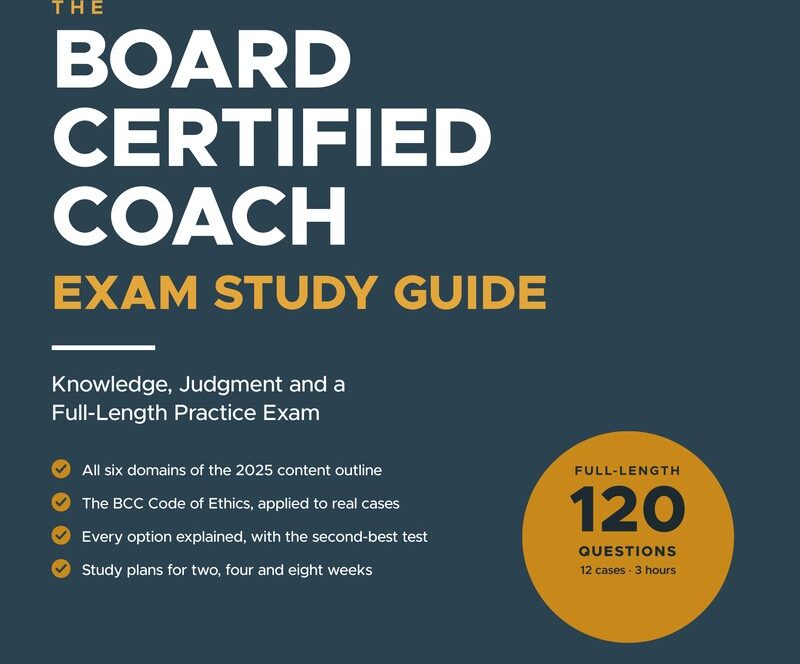
The Board Certified Coach exam (BCCE) measures coaching knowledge and the judgment to apply it. You read 12 case studies, each a short vignette followed by 10 multiple-choice questions, and choose the best of four options for each: 120 items in three hours. CCE’s 2025 content outline spreads the scored items across six domains, from ethics to business practices.
Every copy includes a $50 coupon for the BCC Exam Prep course and simulator. Our study guide teaches all six domains and includes a full-length practice exam in the BCCE’s format.
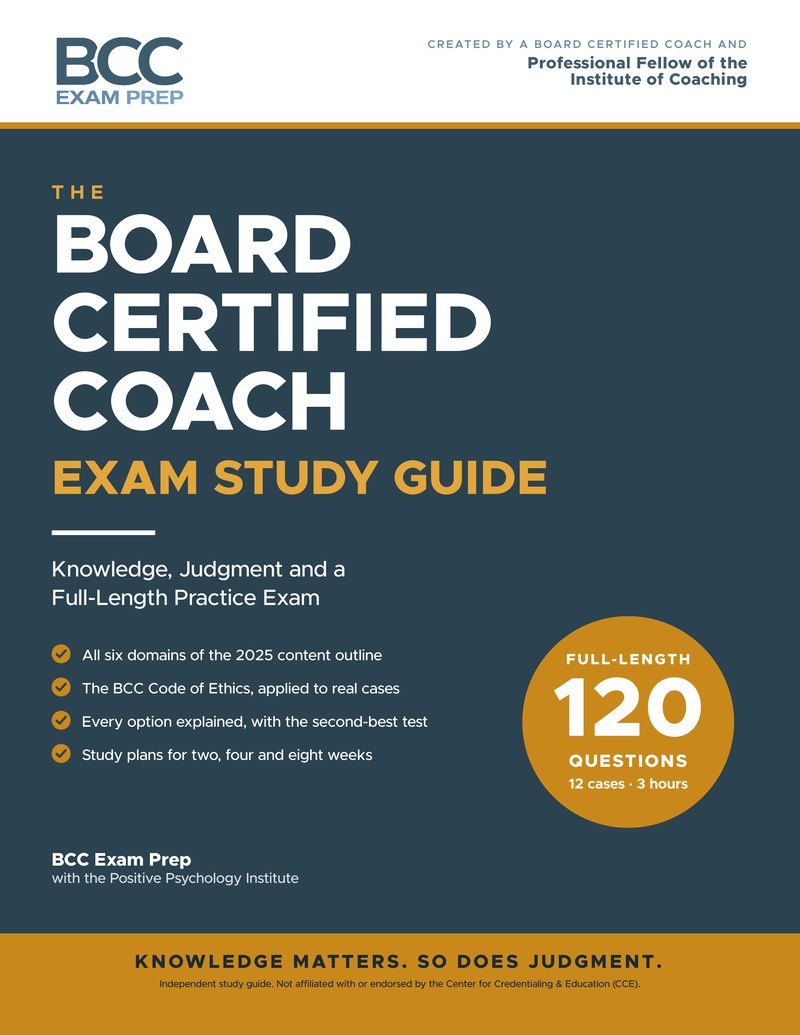
The Board Certified Coach Exam Study Guide
Knowledge, judgment and a full-length, 120-question practice exam with every option explained.
Every copy includes a $50 coupon for the BCC Exam Prep course and simulator.
The Board Certified Coach exam format at a glance
These facts come from CCE’s BCCE Handbook (July 2025).
| Feature | What to expect |
|---|---|
| Structure | 12 case studies, each a vignette followed by 10 multiple-choice questions |
| Total items | 120 |
| Scored items | 100 scored, plus 20 unscored pretest items |
| Options per item | Four |
| Time | 3 hours |
| Pace | About 15 minutes per case, reading included |
A case is not a single question. One vignette supports ten items, and each item can ask something different of the same facts: the first step, the best overall response, the primary focus, or what the coach may tell a sponsor.
Scoring basics: what you can know and what the handbook governs
Each item has one best answer among four options. Of the 120 items, 100 count toward your score and 20 are unscored pretest items. Nothing tells you which are which, so treat every item as scored.
We do not publish fees, eligibility requirements, retest rules or passing standards, because CCE sets them and can change them. CCE’s current BCCE Handbook governs all of these; check it before you register.
The six domains and what each looks like in a case
Here is how each of the six domains in the 2025 content outline tends to appear inside a vignette.
Ethical and Professional Standards (20 percent)
Ethics items rarely announce themselves. A sponsor asks how the client is “really doing.” A client describes weeks of distress that coaching cannot address. A grateful client offers an expensive gift. The BCC Code of Ethics decides these: protect client information and disclose only what the law requires, the client authorizes or the written agreement permits (standard C3); refer when you cannot appropriately help (standard C7); decline significant gifts outside the written agreement (standard D5). Expect cases that test the line between coaching and therapy.
Agreements and Goal-Setting (10 percent)
These cases turn on what was agreed, by whom, and in writing. Watch for coaching that starts before a written agreement is in place (standard C6), a goal written in a sponsor’s words rather than the client’s, a goal that no longer fits the client’s values, or an assessment whose purpose and results the client was never told (standard C5).
Coach Presence and Applied Skills (25 percent)
The heaviest domain asks whether you can choose the right approach for the client in front of you. The case will not name the model. It will describe a client who has drafted a resignation letter three times without sending it, or one who has already given notice and wants help planning the first ninety days. Knowing GROW, the stages of change, motivational interviewing, and cognitive-behavioral and solution-focused coaching is the start; matching them to the client’s state is the skill.
Effective Coach-Client Communication and Rapport (15 percent)
These items look at listening, questioning, silence and feedback. A question that steers the client toward the coach’s preferred answer, a summary the client corrects, a long pause after a hard question, a client who says the sessions feel unhelpful: each asks what keeps the alliance strong while the work continues. A complaint about the process is usually a reason to review how you work together, not resistance to overcome.
Facilitating Client Growth and Accountability (15 percent)
These cases follow insight into action. A client misses the action she chose for the second week running. A goal is met on paper but no longer serves her. An engagement is ending. Strong answers treat a missed commitment as information rather than failure, keep the client in charge of what is tracked, and plan endings that leave the client able to continue alone.
Coaching Business Practices and Professional Development (15 percent)
This domain concerns the coach’s practice: marketing claims, pricing, records, consultation and social media. Credentials and descriptions of services must be accurate (standard C4). Records are kept for five years and then disposed of in a way that protects privacy (standard A6). A coach who seeks a colleague’s advice on a difficult case protects the client’s identity. Together these items carry 15 percent of the score, as much as communication and rapport.
What applied judgment means on the BCCE
Applied judgment is the ability to recognize what a situation calls for and choose the best response for this client, at this point, under this agreement. The exam measures it in three ways.
- Concepts arrive as behavior. A vignette describes what people say and do and leaves the naming to you. A client who agreed to ask three peers for feedback and keeps finding reasons to postpone is showing you something about readiness or confidence; the item tests whether you can tell which.
- Several options are reasonable. Many items include two or more responses a competent coach could defend in some session. The best answer is the one the case facts support now.
- Priorities have an order. When concerns compete, a useful study heuristic runs safety, scope, agreement, relationship, then growth. It organizes your reasoning but is not CCE’s scoring rule; a specific standard or case fact always decides.
This is why the second-best answer is the usual trap. It is often good coaching in general, offered at the wrong time, to the wrong person, or on the strength of a fact the case never states. Our Board Certified Coach exam sample questions walk through that trap with an explanation for every option.
How to read a vignette
Read the vignette straight through once before you look at any item. Then read it again with six questions in mind:
- Who is the client?
- Who pays or sponsors, and what are their legitimate interests?
- What was agreed, and is it in writing? Note goals, confidentiality terms and any reporting.
- Where are we in time, and what has changed since the agreement?
- What safety or scope cues does the case contain, and which does it not contain?
- What is unknown? An option that needs a fact the case never supplies is usually weaker.
Treat each stem as a new instruction
“First” asks for sequence, which may not be the most important step overall. “Best” asks for the strongest response given everything stated. “Most appropriate” often means several options are acceptable and one fits this moment more closely. “Primary focus” asks where attention belongs, not what to do next.
Keep facts and inferences apart
“He has missed two sessions this month” is a fact. “He is losing interest in coaching” is an inference, and an option that makes sense only if the inference is true is the weaker option. When two options survive, name what would have to be true for each to be best, and find the sentence in the case that confirms it. The option the case supports, with nothing added by you, is the answer.
Pacing: about 15 minutes per case
Three hours for 12 cases is about 15 minutes each, reading included. Rehearse with checkpoints at roughly 45, 90 and 135 minutes, after the third, sixth and ninth cases. If one item has taken two minutes, choose the option better supported by facts you can name and move on.
How to prepare for what the exam measures
Because the exam tests knowledge and judgment together, preparation needs both: study each domain, then practice applying it under time. Our guide to how to prepare for the Board Certified Coach exam sets out two, four and eight week plans built on the weights above, and our BCC Code of Ethics guide covers the standards behind many items.
Start with the guide; rehearse with the simulator. The Board Certified Coach Exam Study Guide teaches all six domains and includes a full-length practice exam with every option explained. The course and simulator add timed case simulations in exam mode, with feedback held until the section ends, and a readiness report that shows where your results are strongest and weakest. Together they are the most complete BCC preparation we know of. You can try the course first with the free sample, or compare approaches in BCC exam prep options compared.
Ready for timed, exam-like practice? The BCC Exam Prep course and simulator add timed case simulations in exam mode, a full-length sitting, an explanation for every option and a readiness report. Reading the study guide? Your copy includes $50 off.
BCC Exam Prep is independent of the Center for Credentialing & Education (CCE) and is not endorsed by it.
Frequently asked questions
How many questions are on the Board Certified Coach exam?
The BCCE has 120 multiple-choice items: 12 case studies, each a vignette followed by 10 questions, with four options per item. According to CCE’s July 2025 handbook, 100 of those items are scored and 20 are unscored pretest items. You cannot tell the pretest items apart, so treat every item as if it counts.
How long is the BCC exam?
Three hours for all 12 cases, which works out to about 15 minutes per case, including the time to read each vignette. Rehearse with checkpoints at roughly 45, 90 and 135 minutes so you know whether you are on pace. CCE’s current handbook governs scheduling and the rules of the testing session, so check it before exam day.
Which domain carries the most weight on the BCC exam?
Coach Presence and Applied Skills carries 25 percent of the scored items, the most of any domain, followed by Ethical and Professional Standards at 20 percent. Agreements and Goal-Setting carries 10 percent, and the remaining three domains carry 15 percent each. Ethics deserves extra attention because ethical priorities also decide items in the other domains.
Is the BCC exam a test of memorization?
Not mainly. You need to know the BCC Code of Ethics, the major coaching approaches and professional standards, but the items present that knowledge inside cases and ask what a competent coach would do. Many items offer more than one reasonable-sounding option, so the skill is choosing the best response for this client, at this moment, under this agreement.
Every copy includes a $50 coupon for the BCC Exam Prep course and simulator.
The Board Certified Coach Exam Study Guide
Knowledge, judgment and a full-length, 120-question practice exam with every option explained.
Every copy includes a $50 coupon for the BCC Exam Prep course and simulator.